


Strategy package
Reviewed workloadInterface · tests · decision logicREADY TO CONFIGURE

An automated strategy can compile successfully and still behave badly when volatility jumps, inventory becomes one-sided, data arrives late, or execution costs overwhelm the intended edge.
Steer IDE is the strategy workbench: the place to build the workload, connect its inputs, test its logic, examine historical behavior, and prepare a reviewed candidate for production implementation on the Steer Network.
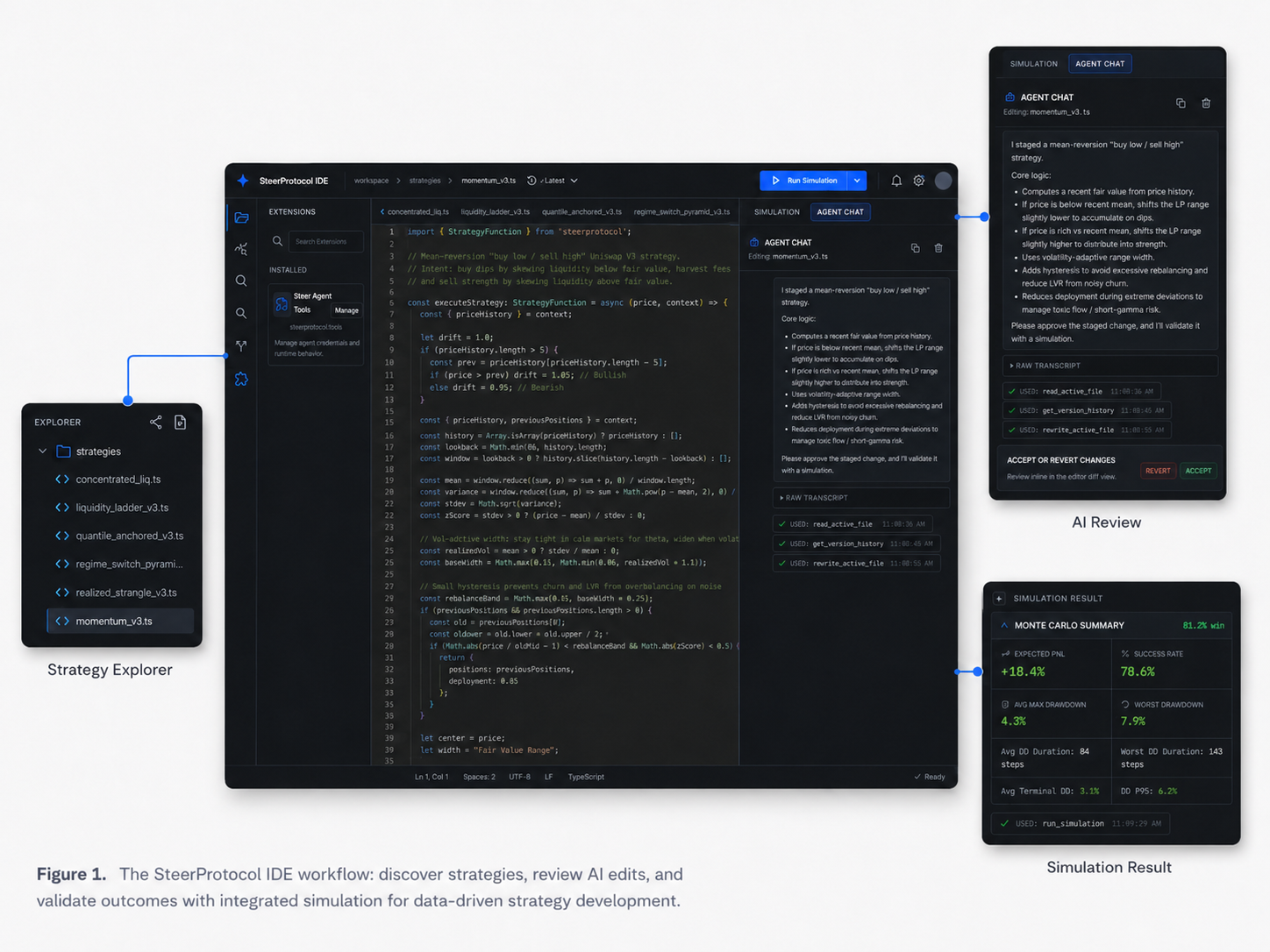
Developers define the application’s configuration, inputs, decision logic, and output format. Tests can exercise the functions and failure cases before the workload becomes part of a live product.
Simulation and backtesting let the author run the strategy against historical inputs and selected scenarios. The point is not to manufacture an attractive return chart. It is to find brittle parameters, unexpected inventory behavior, excessive turnover, and conditions where the strategy should hold rather than act.
The final workload needs a defined interface, valid configuration, expected data dependencies, and an output the Network and downstream product can consume. Review is the boundary between an experiment and a candidate ready for production implementation.
Steer IDE gives developers more than 300 data sources to choose from today—including Uniswap, Aerodrome, stock markets, Deribit, and custom feeds. Choose the inputs a strategy needs and start building.
AVAILABLE TODAY
Choose the feeds your strategy needs.
Reviewed strategy logic can become the starting point for more than one market or product without copying the entire development process. The reusable asset is the reviewed workload; each deployment still requires production implementation plus its own market, parameters, permissions, and risk configuration.
This is how IDE contributes to repeat economics. A strategy that has already been written, tested, and reviewed can become the starting point for another product instead of another bespoke engineering project.
REUSE THE LOGIC
Read the application-development guide · Explore strategy development for Smart Pools