
Product
Steer ALM
An off-the-shelf strategy library, market-hook layer, and operating system for onchain markets
A market starts drifting the moment it opens
Liquidity moves out of range. Inventory becomes one-sided. Volatility changes the useful width of a position. Fees accrue, incentives expire, and a market that looked healthy at launch can become expensive to trade.
Steer ALM combines a library of more than 20 off-the-shelf strategies, a market-hook layer, and the operating system that keeps each deployment attached to its market after capital is deposited.
Different markets need different strategies
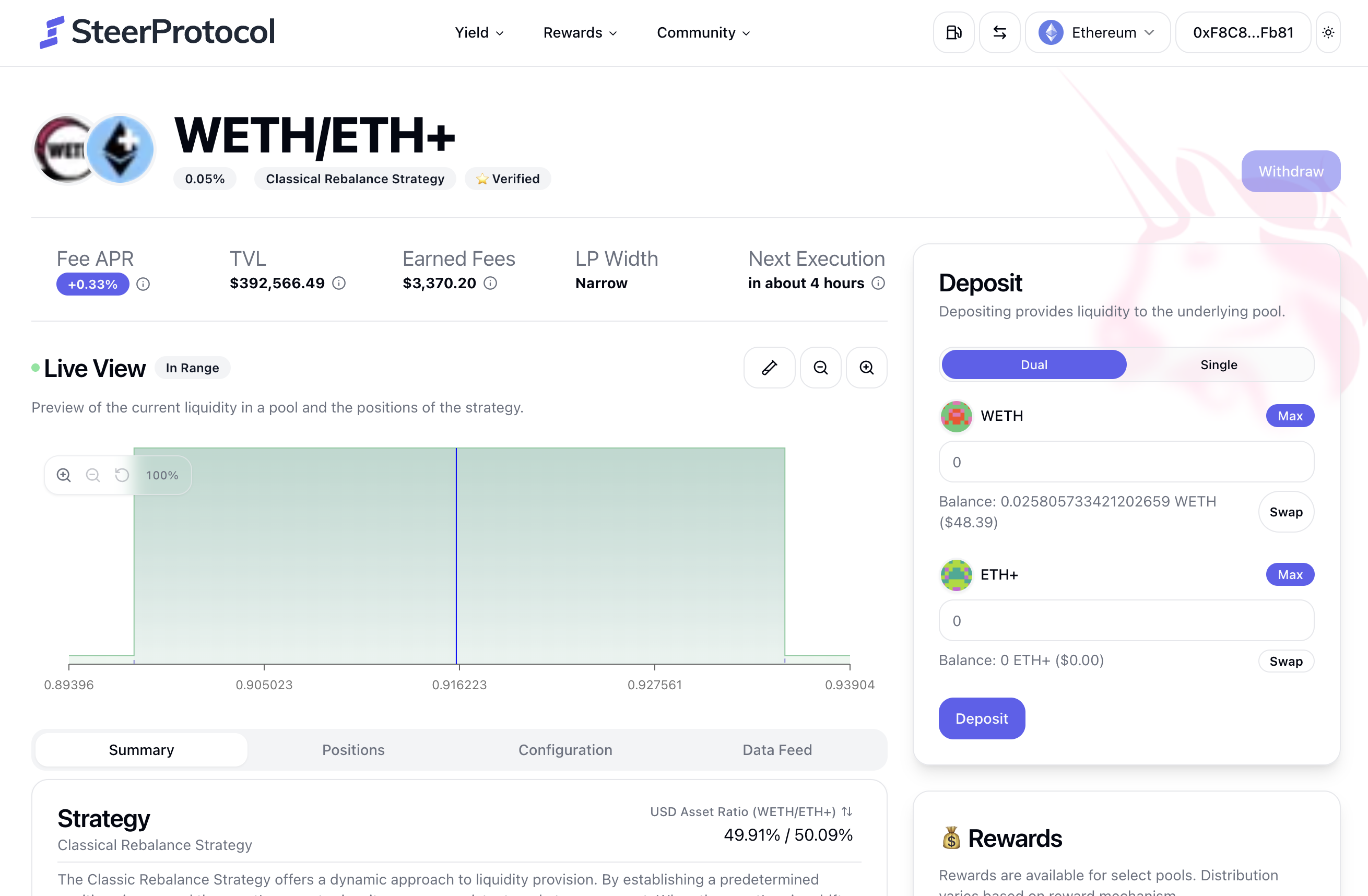
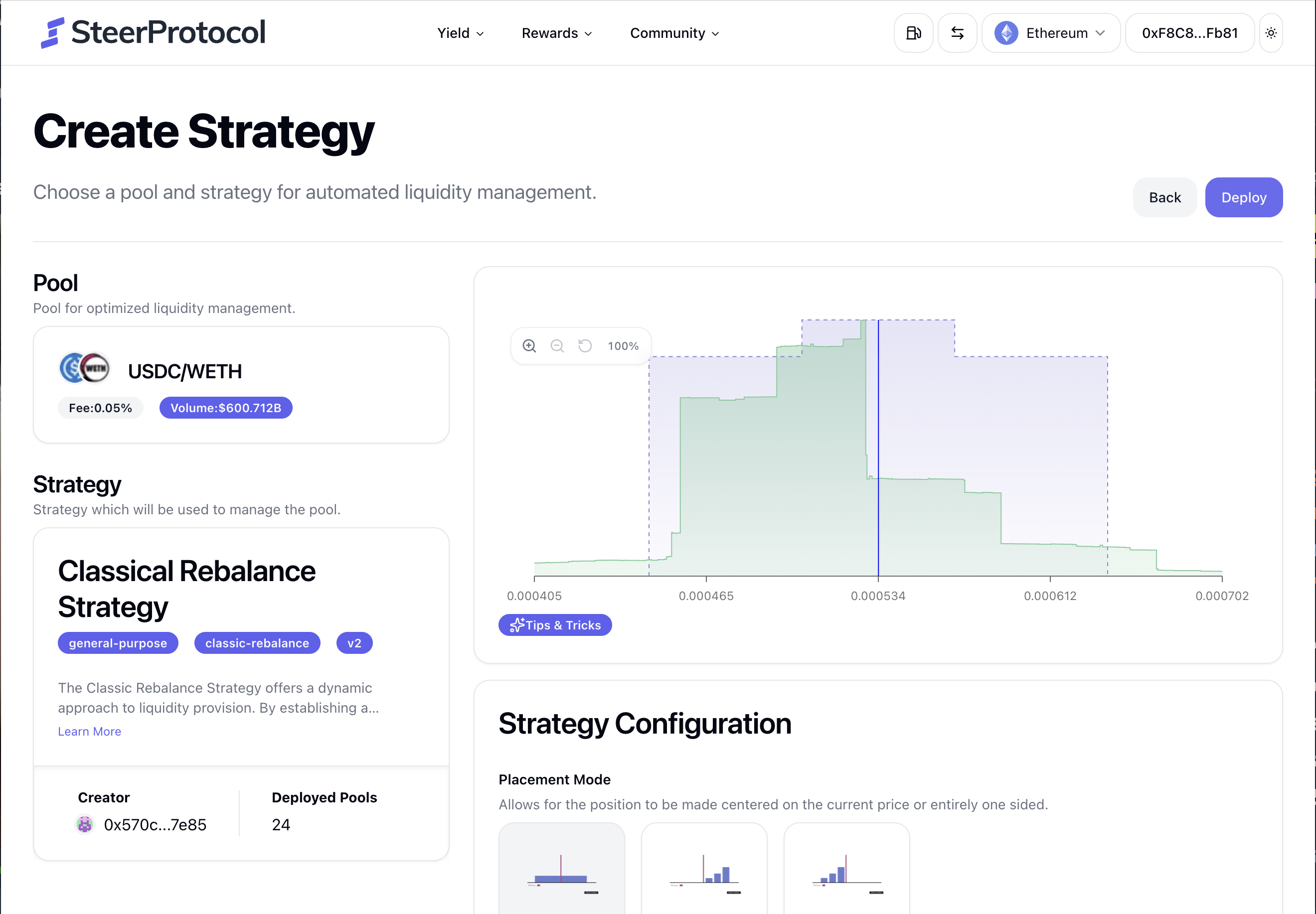
Steer’s strategy catalog documents more than 20 custom strategies available today. Existing strategies can be selected and deployed from the App Store through a no-code flow, while teams that need different logic can build against the same ALM engine.
That breadth matters because a token launch, a stablecoin peg, a treasury mandate, and a tokenized-asset market do not need the same liquidity policy.
| Strategy family or configuration | Market job |
|---|---|
| Market-depth strategies | Position capital where it can create useful depth as market conditions change |
| Treasury-management strategies | Put issuer or protocol inventory to work under a defined allocation and inventory mandate |
| Token-launch (TGE) configurations | Establish liquidity at launch and manage it through early price discovery |
| Single-sided liquidity strategies | Turn one-sided inventory into an operating liquidity position under configured rules |
| Real-world-asset configurations | Configure liquidity for tokenized real-world assets, external pricing inputs, and market-specific constraints |
| Stablecoin strategies | Manage depth and inventory around peg-centered objectives |
| Tokenized-equity configurations | Operate liquidity for tokenized equities under asset-specific pricing and market constraints |
Each deployment combines a reusable strategy with its own assets, capital source, venue, parameters, permissions, and risk bounds. The library shortens the path from a market objective to an operating strategy without treating every market as the same.
From strategy selection to continuous operation
Selecting a strategy is the starting point. Steer Smart Pools place assets in non-custodial vaults whose strategy can evaluate market and position data, return a target allocation, and reposition liquidity through the associated manager.
The same operating cycle—observe, decide, reposition, and account—supports different strategy families while preserving the configuration required for each market.
Hooks extend ALM into the market itself
Strategies determine how capital is allocated over time. Steer-built hooks install logic at the market boundary, so ALM can also control how eligible flow enters a compatible market and how liquidity is sourced for execution.
ALM hook layer
MARKET-NATIVE LOGIC
CONTROL
Permissioned market logic
Apply eligibility and execution policy at the market boundary.
FLOWParticipant or route
HOOKPolicy gate
VENUEConfigured market
- Allowlisted participation
- Signed issuer settlement
CAPITAL
JIT liquidity hook
Stage capital in ERC-4626 lending vaults between swaps, then supply an in-flight trade.
LENDING LAYERERC-4626 vaults
HOOKBefore / after swap
IN-FLIGHT POOLSwap liquidity
- Deploy for the swap
- Return after execution
Permissioned-market hooks can apply eligibility and execution policy before a controlled market path is used. Current patterns include allowlisted vault participation and signed, issuer-authorized settlement routes. This makes permissions part of market execution instead of an offchain operating procedure.
Steer has also developed and tested a Uniswap v4 just-in-time (JIT) liquidity hook. Between swaps, capital can remain in ERC-4626 lending vaults. For an eligible in-flight trade, the hook can move the strategy’s available capital into the pool, remove the temporary position after the swap, and return capital to the lending layer. If inventory first needs a token-ratio adjustment, the system defers to Steer’s managed tend flow.
The JIT hook is a pipeline module rather than an off-the-shelf production deployment. Steer’s publicly documented Algebra Rehypothecation Hook applies the same broader principle—coordinating active AMM liquidity with approved ERC-4626 yield sources—through a swap-aware, strategy-managed model.
Operating history becomes product leverage
Operating history
3 years
Company history through July 2026
Vault deployments
4,000+
Cumulative deployment history
Chains
45
Active in-scope support definition
DEX / AMM integrations
57
Active integration definition
These figures describe Steer’s broader deployment history, not the number of active or funded ALM vaults today. Their importance is architectural: a new partner product can reuse integrations, vault patterns, strategy operations, and market workflows that Steer has already exercised.
From liquidity product to product infrastructure
ALM can be sold directly as managed liquidity, but its larger role is underneath the partner product portfolio.
| Partner product | What ALM contributes |
|---|---|
| Onchain ETF (DTF) with Reserve | Repeat market and portfolio operations across diversified token products |
| Stablecoin Stability Engine with Liquity | Liquidity and lifecycle support around a product-specific stability mechanism |
| Collateral Rail with USDM1 | The pool-liquidity side of a market that also includes controlled issuer settlement capacity |
The same engine can support different products because the market, strategy, and operating configuration remain separable.
Explore the liquidity interface · Read the Smart Pools documentation